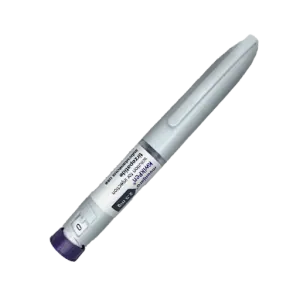

What is Mounjaro?
Mounjaro is a once-weekly injection containing tirzepatide. In the UK it's licensed for weight management in adults with a BMI of 30 or more, or 27 to 29.9 with at least one weight-related health condition, alongside a reduced-calorie diet and more physical activity. It's also licensed for type 2 diabetes.1 We only prescribe it for weight management in adults.
The KwikPen comes in six strengths: 2.5mg, 5mg, 7.5mg, 10mg, 12.5mg and 15mg. Each pen holds four weekly doses.1
You may have read about tirzepatide for sleep apnoea or heart failure. Trials have looked at both, but neither is a licensed use in the UK.1
Does Mounjaro work for weight loss?
For most people, yes. In SURMOUNT-1, 2,539 adults without diabetes took Mounjaro or a dummy injection (placebo) for 72 weeks, alongside diet and activity support. Average weight loss was 15.0% on 5mg, 19.5% on 10mg and 20.9% on 15mg, against 3.1% on placebo.13
Not everyone could stay on it. Side effects led 4.3% to 7.1% of people on Mounjaro to stop, against 2.6% on placebo.13 The trial was funded by Eli Lilly, which makes Mounjaro.
You may see slightly higher figures for the same trial in the Mounjaro licence, such as 22.5% on 15mg. Those are worked out as if everyone had kept taking it, so they describe what the medicine can do rather than what happened to everyone who started.1
What happens if you stop Mounjaro?
Most of the weight tends to come back. In SURMOUNT-4, 670 adults took Mounjaro for 36 weeks and lost an average of 20.9%. They were then split at random: half carried on, and half were switched to a dummy injection without knowing.14
Over the next 52 weeks, those who carried on lost a further 5.5%, while those switched to placebo put 14.0% back on. By the end, 89.5% of people still on Mounjaro had kept at least 80% of their weight loss, against 16.6% of those who'd stopped.14 The trial was funded by Eli Lilly.
It's worth knowing before you start: Mounjaro works while you're taking it, so any decision to stop is one to plan with your prescriber.
How does Mounjaro work?
Tirzepatide acts on GLP-1, the same hormone pathway as Wegovy, and on a second hormone, GIP, which is also involved in appetite and blood sugar control.4 It helps you feel fuller and less hungry, and it slows down how quickly your stomach empties.6
Slower stomach emptying can change how well some tablets are absorbed. That matters most for medicines like warfarin, where small changes in level make a difference.1
It also lowers blood sugar, so the risk of a hypo goes up if you take insulin or a sulfonylurea for diabetes.1
How to get Mounjaro on prescription in the UK
On the NHS in England, Mounjaro is being introduced in stages. NICE recommends it for adults with a BMI of 35 or more and at least one weight-related condition, but said not everyone would be able to get it at first.8
GP practices started in June 2025 with people who have a BMI of 40 or more and at least four of five conditions: heart or circulation disease, high blood pressure, abnormal blood fats such as high cholesterol, sleep apnoea and type 2 diabetes. In 2026/27 this widens to a BMI of 35 to 39.9 with at least four of them. Lower BMI thresholds apply for people from some ethnic backgrounds.9
Privately, a healthcare professional has to assess you before a prescription can be issued.4 With us, that works like this:
- You answer our online questions about your health, your weight history and any medicines you take.
- We confirm your weight independently, by video call or from a recent weight recorded by your GP. Pharmacies that prescribe at a distance have to verify it rather than take it on trust.11
- With your consent, our prescriber checks your Summary Care Record, and we let your GP know what we've prescribed.
- If Mounjaro is suitable, we dispense it and post it in plain packaging.
If a seller doesn't ask these questions, treat that as a warning sign. The MHRA advises against buying these medicines from unregulated sellers such as beauty salons or through social media.4
Who can use our Mounjaro service?
This service is for adults whose weight is in the range Mounjaro is licensed for, and who can be looked after safely at a distance.
This service may be suitable if
- You're aged 18 to 65.
- Your BMI is 30 or more, or 27 to 29.9 with a weight-related condition such as high blood pressure, high cholesterol, prediabetes, type 2 diabetes, sleep apnoea or heart disease.1
- You're registered with a UK GP and happy for us to contact them.
- You're already using a weight loss medicine and want to carry on with us. We'll ask for your current dose, when you last injected and where it came from.
We can't prescribe Mounjaro if
- You're pregnant, breastfeeding, having IVF, or planning a pregnancy in the next 3 months.
- You have type 1 diabetes.
- You've ever had pancreatitis.
- You or a close relative have had medullary thyroid cancer or MEN2.
- You currently have an eating disorder.
- You'd be using it at the same time as another GLP-1 medicine, such as Wegovy, Ozempic or Saxenda.
Some of these are stricter than the licence. They're the rules for our online service.
Tell our prescriber before treatment if
- You have type 2 diabetes, especially if you use insulin or a sulfonylurea such as gliclazide.1
- You have diabetic eye disease (retinopathy).1
- You have severe stomach or bowel problems, such as gastroparesis.1
- You've had gallstones or other gallbladder problems.1
- You have kidney or liver problems.
- You take the contraceptive pill. There's more on this below.
- You take warfarin, digoxin or another medicine where small changes in level matter.1
- You have an operation or a procedure under sedation coming up.6
- You've had an eating disorder in the past, or you have depression or another mental health condition.
Mounjaro results: when can changes appear?
Give it a proper run. You start on 2.5mg for 4 weeks, which is a starting dose rather than a treatment dose, and then move to 5mg. Any further increases are in 2.5mg steps, at least 4 weeks apart.1
NICE's advice for the NHS is that if you've lost less than 5% of your starting weight after 6 months on the highest dose you can manage, it's time to decide with your prescriber whether to carry on.7
Weigh yourself once a week, on the same scales at the same time of day, so you're comparing like with like.
Does Mounjaro make you feel sick?
It often does at first. In the weight management trials, nausea affected 24.6% of people on 5mg and 28% to 29% on 10mg and 15mg, against 8.5% on placebo. Diarrhoea affected 18.7% to 22.5%, against 7.8%.1
Between 1.9% and 4.3% of people stopped Mounjaro because of stomach and bowel side effects, against 0.5% on placebo.1
If sickness is making it hard to eat or drink, do not push on to the next dose increase. Talk to us first, as the prescriber can keep you on your current dose for longer.1
It's best to avoid alcohol while using Mounjaro, because it can make feeling or being sick worse.10
Our guide, Feeling sick on Mounjaro or Wegovy: when to hold your dose, goes through what helps, what to do if you're being sick, and when it's time to get help.
How to use Mounjaro KwikPen
| When | Weekly dose |
|---|---|
| Weeks 1 to 4 | 2.5mg, the starting dose |
| Week 5 onwards | 5mg |
| After at least 4 weeks on a dose | Can go up by 2.5mg if needed |
| Usual maintenance doses | 5mg, 10mg or 15mg |
| Maximum | 15mg |
The schedule comes from the Mounjaro licence.1 Your prescriber may keep you on a dose for longer.
- Inject once a week, on the same day each week if you can, at any time of day, with or without food.2
- Inject under the skin of your stomach or thigh. The back of the upper arm works too, but you'll need someone to help.2
- You can change your injection day, as long as it's been at least 3 days since your last injection.2
- If you miss a dose and it's 4 days or less since you should have taken it, take it as soon as you remember. If it's more than 4 days, skip it and take your next dose on your usual day. Do not take a double dose.2
- Each KwikPen holds four doses. Throw it away after the fourth even if there's some medicine left, and do not try to get the leftover out.14
- Do not change your dose or stop without talking to us first.
The leaflet in the pack has step-by-step instructions for using the pen. Read it before your first injection.2
Storing your pens. Keep new pens in the fridge at 2°C to 8°C and never freeze them. Once you've started a pen, you can keep it out of the fridge, at no more than 30°C, for up to 30 days. After that, throw it away.2
Side effects of Mounjaro
Reported side effects
Very common (more than 1 in 10 people): feeling sick, diarrhoea, being sick, constipation, stomach pain and loss of appetite.1
Common (up to 1 in 10 people): allergic reactions, dizziness, low blood pressure, indigestion, bloating, burping, wind, reflux, gallstones, hair loss, tiredness, injection site reactions, and raised calcitonin or lipase in blood tests.1
In the weight management trials, gallbladder problems were more common in people who lost more weight.1
Hair loss in the trials was mostly mild, most people recovered while staying on treatment, and nobody stopped Mounjaro because of it.1 Our guide, Mounjaro, Wegovy and hair loss, explains what the evidence shows and what helps.
When to stop and get help
Most side effects aren't a reason to worry. These are.
Call 999 or go to A&E if you have:
- Rapid swelling of your lips, tongue or throat, difficulty swallowing, breathing problems or a fast heartbeat. This could be a severe allergic reaction, which is rare.2
- Severe stomach pain that won't go away, which may spread to your back and come with feeling or being sick. This can be a sign of pancreatitis. In January 2026 the MHRA strengthened its warning after rare severe and fatal cases with these medicines.25
Get advice the same day if you can't keep fluids down, or you're losing a lot of fluid through vomiting or diarrhoea. Severe dehydration can affect your kidneys.14
These symptoms don't always mean something serious is wrong, but they need checking. You can report any side effect to the MHRA Yellow Card scheme.12
The MHRA has also looked at reports of depression and suicidal thoughts with GLP-1 medicines. It says the evidence doesn't support a causal link, and it's still monitoring.4 Tell us if your mood changes.
Mounjaro, the pill, pregnancy and breastfeeding
The pill. Mounjaro may make the pill less reliable if you're overweight. If you take the combined pill or the progestogen-only pill, use condoms as well, or switch to a method that isn't a pill, such as the implant or a coil, for 4 weeks after starting Mounjaro and for 4 weeks after every dose increase.24
Pregnancy. Do not use Mounjaro if you're pregnant. If you're planning a pregnancy, stop it at least 1 month before.14 If you get pregnant while using it, stop and speak to us or your GP straight away.4
Breastfeeding. The Mounjaro leaflet now says only very small amounts pass into breast milk, and to talk to your doctor before using it while breastfeeding.2 The MHRA's advice is still that GLP-1 medicines shouldn't be taken while breastfeeding.4 Our service doesn't prescribe Mounjaro if you're breastfeeding.
Mounjaro, operations and other medicines
Because Mounjaro slows down how quickly your stomach empties, there's a possible risk of stomach contents getting into your lungs under a general anaesthetic or deep sedation. If you're having an operation or a procedure such as an endoscopy, tell the team, including the anaesthetist, that you use Mounjaro. Do not stop it without discussing it with them first.6
Tell us about every medicine you take, including ones you buy. In particular:
- insulin or a sulfonylurea, as the risk of low blood sugar goes up.1
- warfarin, digoxin or another medicine where small changes in level matter, as these may need checking when you start and after each dose increase.1
- the contraceptive pill, as covered above.2
- any other GLP-1 medicine, which shouldn't be used at the same time.
If you're thinking of switching between Mounjaro and another weight loss medicine, speak to a prescriber first. The MHRA warns that switching without advice can make side effects more likely or the treatment less effective.4
How do Mounjaro and Wegovy compare?
The only head-to-head trial so far, SURMOUNT-5, gave 751 adults with obesity but not type 2 diabetes the highest dose of either medicine they could manage for 72 weeks. Average weight loss was 20.2% on Mounjaro and 13.7% on Wegovy.15 People knew which medicine they were taking, and the trial was funded by Eli Lilly, which makes Mounjaro.
That's a real difference, but it isn't the whole story. Wegovy is licensed to lower the risk of heart attack and stroke in people with heart or circulation disease, and Mounjaro isn't.13 Our guide, Wegovy vs Mounjaro: which is better for weight loss?, goes through the evidence and when Wegovy might still be the better fit.
Support after you start
Mounjaro is a long-term treatment, and you can come back to us with questions at any point.
- If sickness, diarrhoea or constipation is getting in the way of eating and drinking, tell us rather than waiting for your next order.
- Tell us before your next order if you've started a new medicine, have an operation coming up or are planning a pregnancy.
- Do not increase, lower or stop your dose on your own. Ask us and the prescriber will advise.
- If something doesn't feel right, get in touch. Our pharmacists are happy to talk it through.
Mounjaro FAQs
Can I buy Mounjaro without a prescription?
No. Mounjaro is a prescription-only medicine, so a prescriber has to assess you before it can be supplied. The MHRA warns against buying it from anyone who skips that step.4
Can I get Mounjaro on the NHS?
Possibly. In England it's being brought in gradually, starting with people who have the highest BMI and several weight-related conditions.9 Your GP can tell you whether you qualify yet.
How much weight will I lose on Mounjaro?
Nobody can tell you that in advance. In SURMOUNT-1 the average was 15.0% to 20.9% over 72 weeks depending on the dose, against 3.1% on placebo. Those are averages, and your result may be higher or lower.13
Do I need extra contraception on Mounjaro?
Yes, if you take the pill. Use condoms as well, or a method that isn't a pill, for 4 weeks after starting and for 4 weeks after each dose increase.2
What happens if I miss a dose?
If it's 4 days or less since your usual day, take it as soon as you remember. If it's more than 4 days, skip it and carry on from your next usual day. Do not take a double dose.2
Is 2.5mg meant to make me lose weight?
Not really. It's a starting dose. After 4 weeks you'd normally move to 5mg, and the doses meant for longer-term treatment are 5mg, 10mg or 15mg.1
Can I drink alcohol on Mounjaro?
It's best to avoid it. Alcohol can make feeling or being sick worse.10
Does Mounjaro cause hair loss?
It can. Hair loss is a listed common side effect, mostly mild, and most people in the trials recovered while staying on treatment.1 Our guide to hair loss on Mounjaro and Wegovy explains what's happening and what helps.
Do I need to stop Mounjaro before an operation?
Do not stop it on your own. Tell the team doing the operation, including the anaesthetist, that you use Mounjaro, and follow their advice.6
Is Mounjaro licensed for sleep apnoea?
Not in the UK. Trials have looked at it, but the UK licence covers weight management and type 2 diabetes only.1
How should I store Mounjaro?
In the fridge until you start a pen, and never frozen. Once started, a pen can be kept out of the fridge at no more than 30°C for up to 30 days, then thrown away.2
What happens when I stop Mounjaro?
Most people put a lot of the weight back on. In SURMOUNT-4, people switched to placebo put 14.0% back on over a year, while those who carried on lost a further 5.5%.14 Plan any stop with your prescriber.
Can I switch from Wegovy to Mounjaro?
Yes, but not on your own. Speak to a prescriber first, as switching without advice can make side effects more likely or the treatment less effective.4 We'll ask for your current dose and when you last injected.
Clinical sources and further information
Regulatory and clinical guidance
- eMC: Mounjaro KwikPen summary of product characteristics, last updated 8 September 2026 (accessed 13 November 2026)
- eMC: Mounjaro KwikPen patient information leaflet, revised August 2026 (accessed 13 November 2026)
- eMC: Wegovy 2.4mg FlexTouch summary of product characteristics, last updated 22 September 2026 (accessed 13 November 2026)
- MHRA: GLP-1 medicines for weight loss and diabetes: what you need to know, updated 5 February 2026 (accessed 13 November 2026)
- MHRA Drug Safety Update: strengthened warnings on acute pancreatitis with GLP-1 medicines, 29 January 2026 (accessed 13 November 2026)
- MHRA Drug Safety Update: GLP-1 medicines and the risk of aspiration during general anaesthesia or deep sedation, January 2025 (accessed 13 November 2026)
- NICE TA1026: tirzepatide for managing overweight and obesity, December 2024 (accessed 13 November 2026)
- NICE TA1026: information for the public
- NHS England: interim commissioning guidance for tirzepatide, updated after an April 2026 review (accessed 13 November 2026)
- NHS: tirzepatide, reviewed 15 May 2026 (accessed 13 November 2026)
- GPhC: guidance for registered pharmacies providing pharmacy services at a distance, February 2025 (accessed 13 November 2026)
- MHRA Yellow Card scheme
Published studies
- SURMOUNT-1: 2022 randomised trial of tirzepatide in 2,539 adults without diabetes. Jastreboff AM et al. N Engl J Med. 2022. DOI: 10.1056/NEJMoa2206038 (accessed 13 November 2026)
- SURMOUNT-4: 2024 randomised trial of continuing or stopping tirzepatide in 670 adults. Aronne LJ et al. JAMA. 2024. DOI: 10.1001/jama.2023.24945 (accessed 13 November 2026)
- SURMOUNT-5: 2025 head-to-head trial of tirzepatide and semaglutide in 751 adults. Aronne LJ et al. N Engl J Med. 2025. DOI: 10.1056/NEJMoa2416394 (accessed 13 November 2026)